
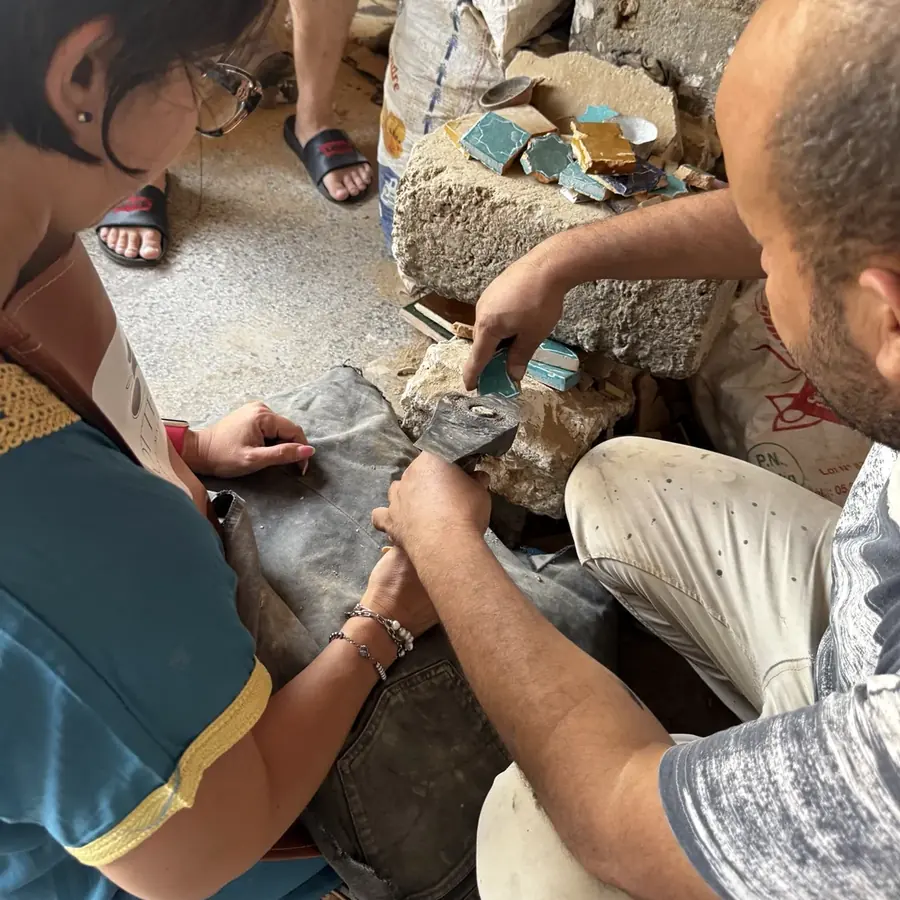
A zellige workshop in Marrakech lets you cut, shape and assemble Moroccan tile mosaic with your own hands, guided by an experienced artisan. The class lasts two hours, welcomes beginners and families, and starts from 60€ per person. All materials and tools are provided, and you finish by assembling a small zellige piece that you take home. This guide explains what zellige is, what actually happens in the workshop, who it is for, and how to book, so you know exactly what to expect before you arrive.
Unlike a short demonstration where you watch someone else work, this workshop puts the tools in your hands. You cut the tiles with a hammer, as a maâlem, a master craftsman, would, and you leave with a piece you made yourself.
What is zellige?
Zellige (also written zellij) is the traditional Moroccan art of mosaic made from small, hand-cut, glazed clay tiles. Pieces of different colours and shapes are fitted together into geometric patterns: stars, rosettes and interlacing forms that repeat across a surface. You see it everywhere in Morocco: on fountains in courtyards, on the lower walls of palaces and mosques, on floors, tables and doorways. In Marrakech, places such as the Bahia Palace and the city’s old medersas are famous for it.
The name comes from the Arabic word for a small polished tile, and the craft has a long history in Moroccan cities, with Fès traditionally considered one of its great centres. What makes zellige special is that it is made entirely by hand. Each tile is slightly different in tone and thickness, which gives walls and floors the shimmer and depth that machine-made tiles lack.
In the workshop, you learn the history of zellige, the types of Moroccan tiles and the geometry behind each design. It is as much about understanding Marrakech, its colours, rhythms and heritage, as about making an object.
How zellige is traditionally made
Knowing the process helps you appreciate what you will try. In traditional workshops, zellige begins with clay, which is shaped into tiles and fired, then glazed in a colour and fired again. The finished glazed tiles are then cut by hand into precise geometric shapes using a sharp hammer. The artisan often works from memory, trained over many years to cut a perfect shape in a few strokes. The small pieces are then arranged in the pattern, usually face down, before a backing is applied to hold the mosaic together.
It is skilled, repetitive and physical work, and it explains why genuine zellige is valuable. In the workshop, you learn the first part of this craft: the cutting, shaping and assembling of tiles into a pattern.
What happens in the workshop, step by step
The session lasts two hours and is organised in five steps.
1. Welcome
You meet your artisan and discover the history of zellige. This short introduction sets the context and helps you understand what you are about to make.
2. Learn the patterns
The artisan explains the types of Moroccan tiles and the geometry behind each design. You see how simple shapes combine into complex patterns, and you choose or are guided toward a pattern that suits a beginner.
3. Cut
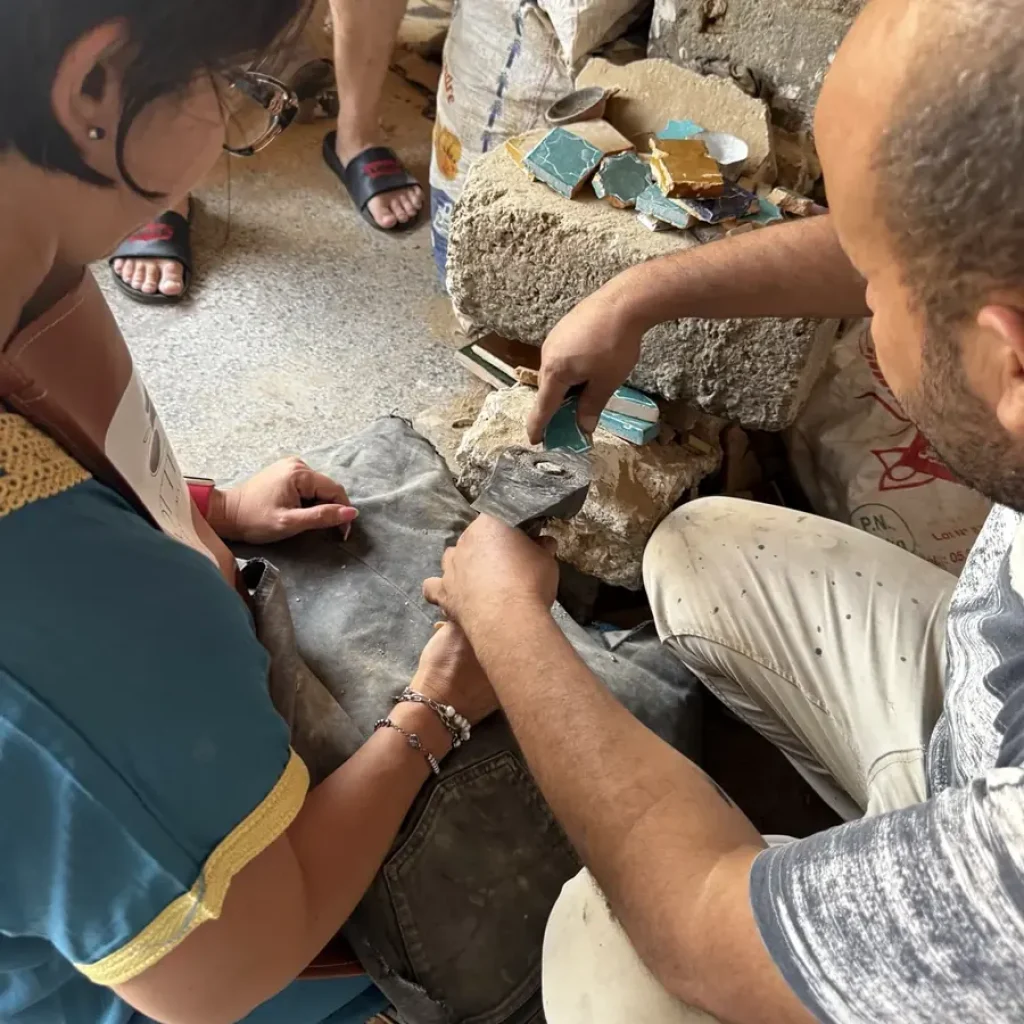
This is the most distinctive part. You cut the tiles with the hammer and a steady hand, as a maâlem does. The artisan shows you how to hold the tile, where to strike and how much force to use. It takes concentration, and it feels very satisfying when a clean shape comes away.
4. Shape and assemble
You shape each piece, with the help of an experienced Moroccan artisan, and then assemble the pieces into a traditional pattern, piece by piece, on the glass table. This is the puzzle-like stage: you choose where each colour goes, and the pattern slowly appears.
5. Take it home
Your small zellige piece is yours to keep. You leave the same day with something you made, which is not the case for every craft: pottery, for example, needs drying and firing before it is finished.
Do I need experience?
No. The workshop is open to all levels, including beginners and families. The artisan guides you through each gesture, and you do not need to be good at drawing, geometry or crafts. What helps is patience and a little curiosity.
The most common surprise is how physical cutting is. The tile is hard, and you need to strike with intention. The artisan shows you the technique, and after a few attempts most guests cut with more confidence. Some pieces will break differently than you expect, and that is part of learning: the artisan knows how to work with the material, and you learn by doing.
Where you will see zellige in Marrakech
One of the pleasures of taking the workshop early in your stay is that the city becomes more legible afterwards. Once you have cut a tile yourself, you start to notice how much hand work stands behind every wall. A few places where zellige is easy to spot:
- Palaces and historic buildings. The Bahia Palace is a well-known example, with rooms and courtyards covered in tile and decorated panels.
- Medersas and monuments. Historic religious schools and tombs often combine zellige with carved plaster and cedar wood.
- Riads and courtyards. Many riads have a tiled fountain at the centre, and a lower wall covered in mosaic.
- Doorways and tables. In the medina and in craft shops, you will find tables and basins with zellige tops.
When you look closely, you can see the slight irregularities between pieces, the way colours shift with the light, and the repeating geometry that makes a pattern feel calm. After a class, many guests tell us that they walk more slowly through the medina because they see so much more.
Zellige compared with ordinary tile
A fair question is why zellige is considered a craft, while a standard ceramic tile is a product. The difference lies in how each is made and in the result:
| Zellige | Industrial tile | |
|---|---|---|
| Shape | Cut by hand from glazed tiles into many small shapes | Uniform shapes, cut by machine |
| Surface | Slightly uneven, with variations in colour and shine | Even and consistent |
| Pattern | Assembled piece by piece into geometric designs | Usually printed or repeated |
| Skill | Years of training for the cutter and the assembler | Automated production |
This is why a zellige wall seems to glow differently at different times of day, and why craftspeople are proud of their work. When you make your small piece, you take part in that tradition on a miniature scale.
Caring for your piece at home
Your small zellige piece is a handmade object, and a little care keeps it looking good. Wrap it in clothing or soft paper for the journey, keep it in your hand luggage if it is fragile, and avoid knocks and drops. At home, display it somewhere stable, such as a shelf or a table. If you have questions about the best way to pack or display it, ask the artisan at the end of the class.
What is included, and what does it cost?
The zellige workshop starts from 60€ per person. Included in the price:
- All materials and tools
- Instruction and guidance from an experienced Moroccan artisan
- The history of zellige and an introduction to the patterns
- Your small zellige piece to take home
The session lasts two hours. Children aged 5 and above are welcome, and groups of up to 50 people can be accommodated. If you are booking for a family or a larger group, tell us the number of participants and the children’s ages, and we will plan the session accordingly. Cancellation is free up to one day before your class.
What to wear
- Comfortable clothes you do not mind getting dusty. Cutting tiles produces small fragments and dust.
- Closed shoes. A workshop floor with tile pieces is not the place for sandals.
- No dangling jewellery. Remove rings, long bracelets and necklaces that could get in your way.
- Tie back long hair. It keeps your face clear while you concentrate.
- Water in warm weather. Marrakech can be hot, and you will be concentrating for two hours.
Tips for a better first zellige piece
- Listen first, strike second. The artisan’s demonstration shows exactly how to hold the tile and where to hit. Watch the angle of the hammer.
- Use a steady rhythm. Short, controlled strikes work better than one hard blow.
- Choose colours deliberately. Before you assemble, lay out your pieces and look at the balance of colours. Contrast makes a pattern readable.
- Start from the centre of the pattern. Geometric patterns grow from the middle outward. Placing the centre correctly keeps everything aligned.
- Accept small gaps. Even masters have tiny differences between pieces. The handmade look is part of the charm.
- Ask about the patterns around you. Afterwards, when you walk through the medina, you will see zellige everywhere, and you will recognise how it was made.
How to prepare before you come
You do not need to prepare anything, but a little curiosity helps. Before your class, take a few minutes to look at photos of zellige patterns, or simply notice the tiles in your riad or hotel. Pick two or three colours you like, because you will be asked to choose. If you travel with children, explain that they will cut small tiles with a tool and that the artisan will show them how. Arrive a few minutes early so you can settle in, meet your artisan and ask any questions before the cutting starts.
Zellige, pottery or ceramic painting?
Our three workshops are all two hours long, beginner friendly and led by local artisans, but they suit different tastes.
| Workshop | What you do | From | Best if |
|---|---|---|---|
| Zellige | Cut and assemble Moroccan tile mosaic, take a small piece home | 60€ | You love patterns, architecture and a physical craft |
| Poterie | Wheel throwing, hand-building and glazing | 40€ | You want to shape clay and try the wheel |
| Ceramic painting | Paint a plate, bowl or tile with Moroccan motifs and keep it | 40€ | You prefer colour and drawing |
Zellige is the one to choose if you want to connect directly with the patterns you see on Marrakech’s walls and fountains. If you want a gentler, more colourful activity, ceramic painting draws on the same motifs. For a deeper look at the clay side, see our guide to pottery classes in Marrakech for beginners.
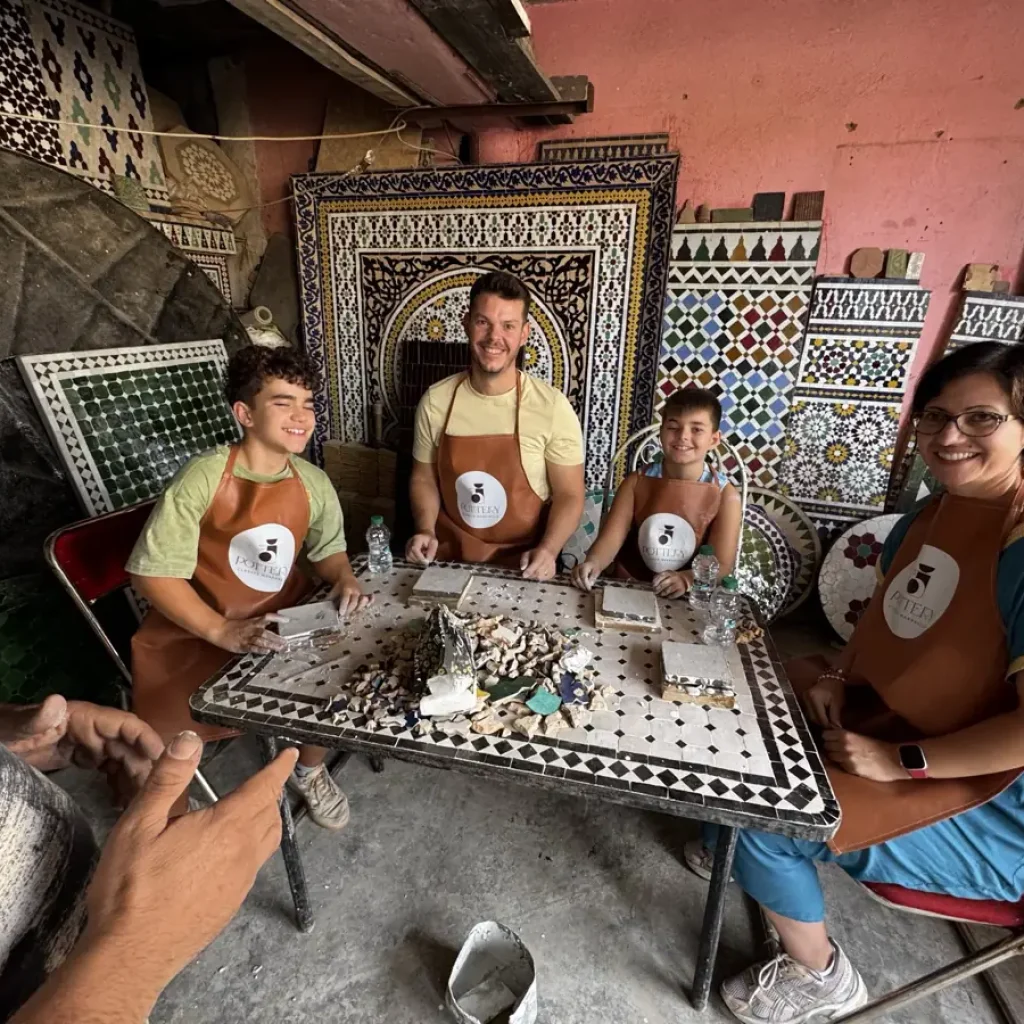
Who is it for?
- Curious travellers who want to understand the architecture they are photographing.
- Families. Children aged 5 and above can join, and parents can work alongside. See our guide to family workshops in Marrakech.
- Couples and friends who enjoy making something together.
- Residents of Marrakech looking for a creative break and a way to bring visitors somewhere authentic.
- Groups and companies of up to 50 people.
Where is the workshop, and how do you book?
Bookings are made through our office in Guéliz, Marrakech, and the workshop address follows your confirmation. Message us on WhatsApp at +212 660 86 10 10 with your date and the number of guests, or choose your date and book online on the zellige workshop page. You can also write to book@potteryclassmarrakech.ma.
If you would like to take home a handmade piece without a class, visit our shop, where artisans of Marrakech make ceramic cups, mugs, bowls and a plate.
Frequently asked questions
How long is the zellige workshop?
Two hours.
Do I need experience to make zellige?
No. It is open to all levels, including beginners and families, and an artisan guides each step.
What do I take home?
You assemble a small zellige piece and take it home the same day.
Can children join?
Children aged 5 and above are welcome. Tell us their ages when you book.
How much does it cost?
The workshop starts from 60€ per person, with all materials and tools provided.
Is zellige difficult?
Cutting needs concentration and a steady hand, but the artisan teaches the technique step by step. Most beginners manage a clean piece after a few attempts.
How many people can join?
Bookings start from one guest, and groups of up to 50 people can be accommodated.
Is it only for tourists?
No. Many residents of Marrakech join to try something new, or to bring friends and family who are visiting.
Ready to make your own zellige? Book your zellige workshop in Marrakech or message us on WhatsApp.

Comment (0)