
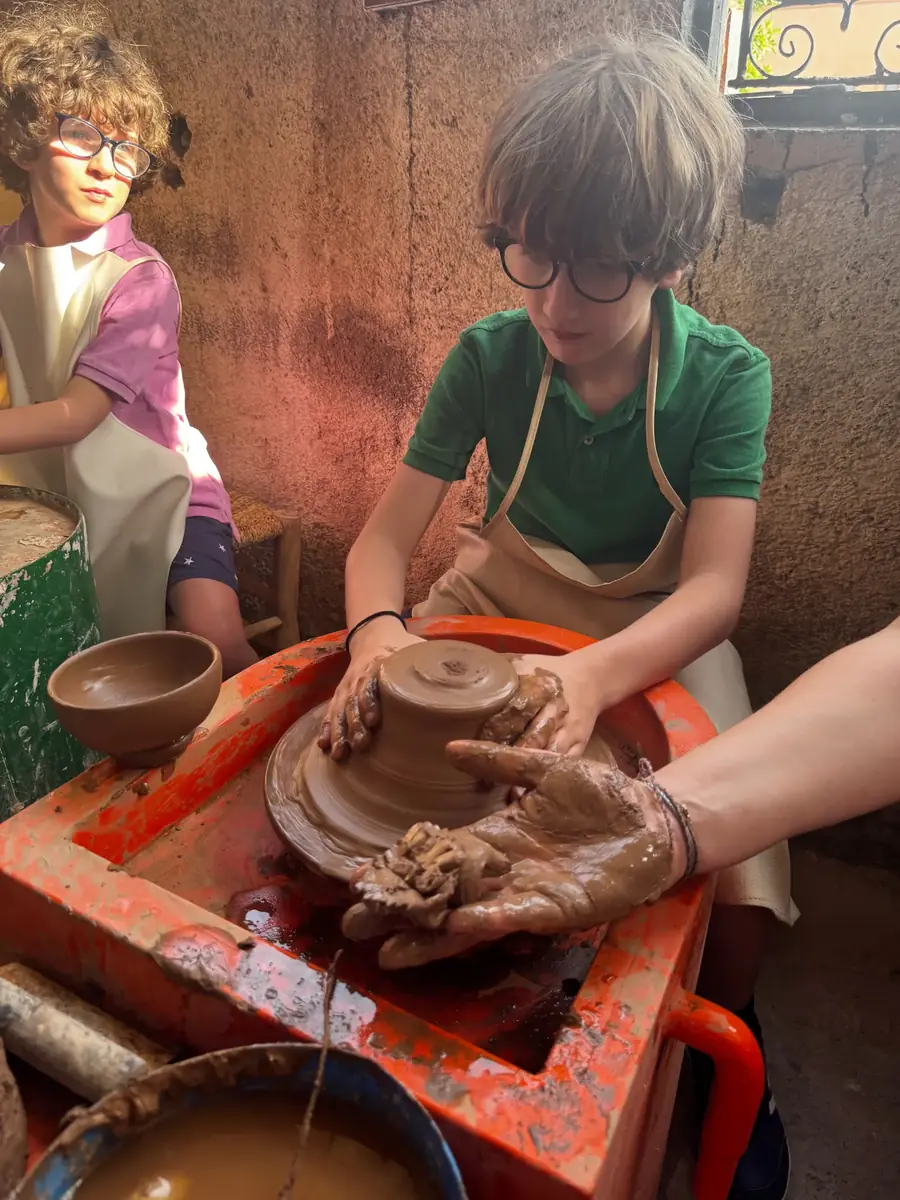
A family pottery class in Marrakech is one of the easiest ways to give children a real, hands-on experience of Moroccan craft. Parents and kids sit in a traditional workshop, a local artisan guides every gesture, and everyone leaves with something they made themselves. Our workshops last two hours, welcome complete beginners, and start from 40€ per person for pottery and ceramic painting and 60€ for zellige. This guide helps you choose the right workshop for your children’s ages, explains how a family session unfolds, and gives practical tips so the afternoon is calm and fun.
Families are a big part of who books with us. Guests regularly describe a relaxed afternoon where the artisan is patient with children, and where parents end up as absorbed as their kids. That is exactly what we hope for.
Why pottery works so well with children
Most holiday activities with children involve watching: a monument, a market, a show. Pottery is the opposite. Children use their hands, their patience and their imagination, and they see a result appear in front of them. A few reasons it works:
- It is physical and calming at the same time. Working wet clay with your hands is absorbing. Many children who are restless in a museum are completely focused for an hour at the wheel.
- It has a clear beginning and end. A child starts with a lump of clay and finishes with an object. That sense of completion is powerful, especially for children who are used to screens.
- Nobody expects perfection. A bowl that leans a little is charming. Children are far less self-critical than adults, and parents often learn something from watching them.
- It connects them to a culture. Clay is part of daily life in Morocco: tagines, bowls, tiles and fountains. Making a piece themselves gives children a way to understand what they see in the medina.
- It is shared. Parents and children work side by side, which is rare on a trip where everyone usually runs on a tight schedule.
Which workshop for which age?
We offer three hands-on workshops, each lasting two hours. Because they use different materials and tools, they suit different ages and temperaments.
| Workshop | What children do | Good to know |
|---|---|---|
| Ceramic painting | Choose a plate, bowl or tile, sketch a design and paint it with traditional Moroccan motifs | Calm and colourful. Children aged 5 and above are welcome, and groups, couples and families enjoy it together |
| Zellige | Cut, shape and assemble tiles into a traditional geometric pattern and take a small piece home | Les enfants à partir de 5 ans sont les bienvenus |
| Poterie | Shape clay on the wheel and by hand, then glaze | Les enfants à partir de 5 ans sont les bienvenus |
If you are not sure which fits, tell us your children’s ages on WhatsApp and we will advise you. It is easier to choose well in advance than to discover on the day that a workshop is not the right match.
Ceramic painting: the gentlest start
Painting a plate, bowl or tile is the easiest first experience for younger children. There is no wheel, no heavy material and no waiting: they choose a piece, pick their colours, and paint. The artisan introduces traditional motifs, inspired by zellige and Fassi pottery, and shows how to hold the brush and build a pattern. Children usually love the freedom of choosing their own colours. Everything is included, together with a hot or cold drink while you paint, and you keep the finished piece.
Zellige: concentration and geometry
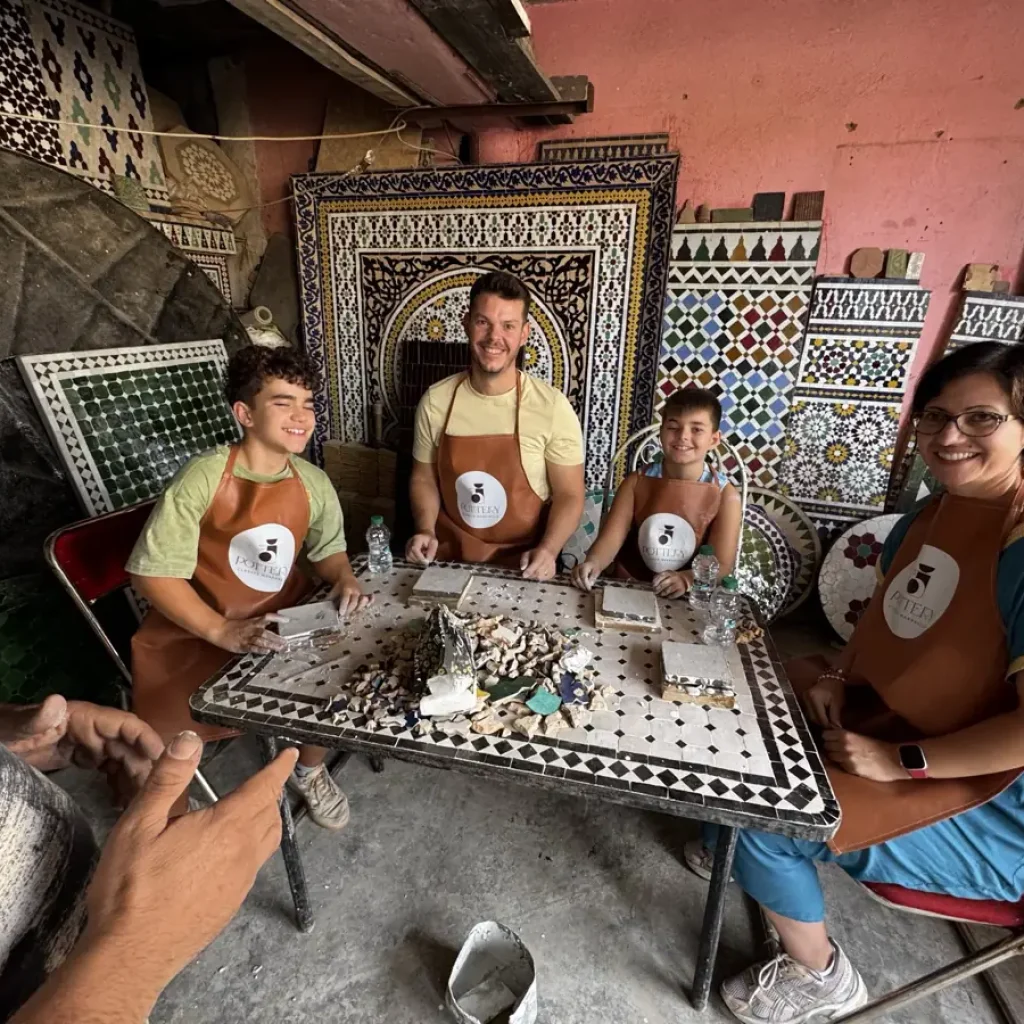
Zellige is cutting and assembling small coloured tiles into patterns, the technique behind the mosaics you see on fountains, walls and floors across Morocco. In our workshop, children aged 5 and above cut and shape pieces with the guidance of an artisan, then assemble a pattern piece by piece. It rewards children who like puzzles, and the finished piece is a small tile to take home. A parent working alongside is a good idea for the youngest participants.
Pottery: wheel and hand-building
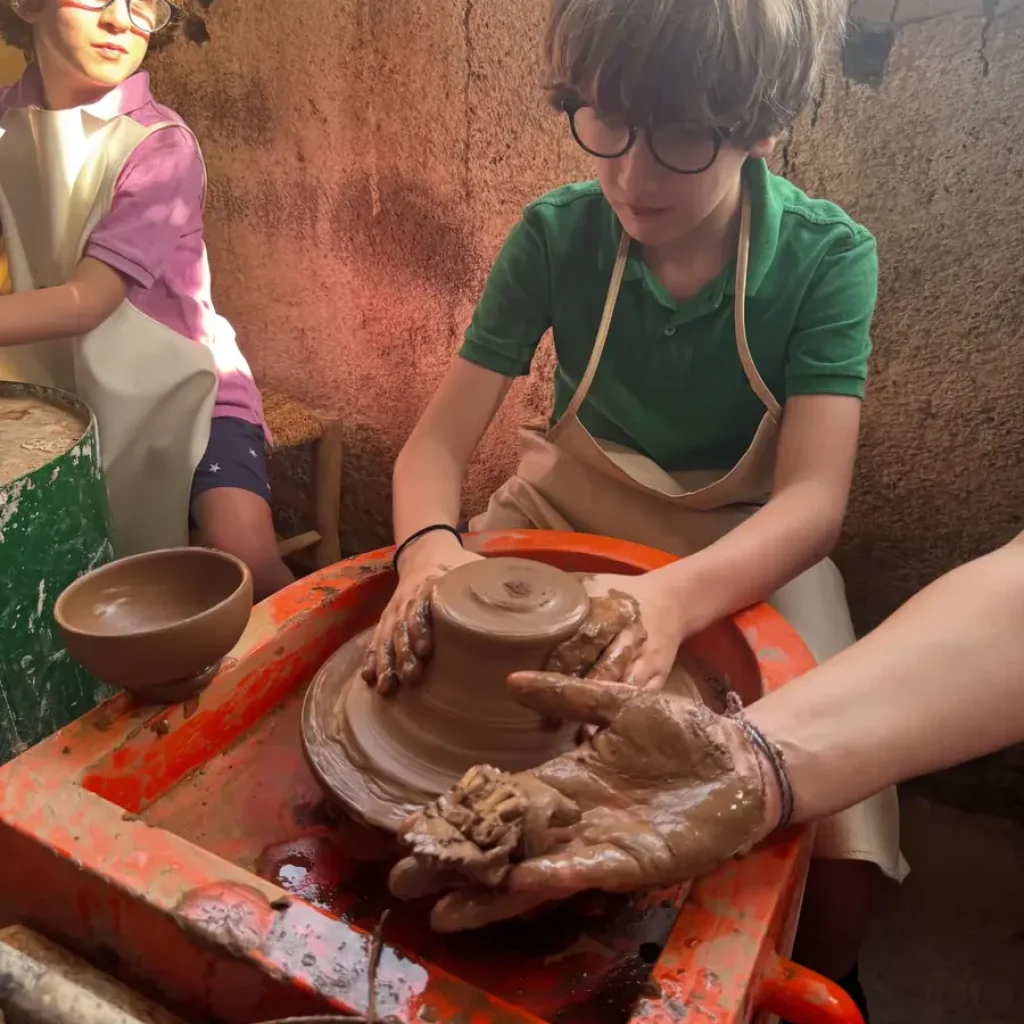
The pottery workshop combines wheel throwing, hand-building and glazing. Older children and teenagers often love the wheel, because it feels like a real skill. Hand-building, which means pinching, coiling and rolling clay without the wheel, is slower and more forgiving. Children aged 5 and above are welcome, and for the youngest, hand-building is the gentlest way to start.
How a family session unfolds
Each workshop lasts two hours and follows a rhythm that works well for families, with a welcome, a short introduction, then plenty of hands-on time. Here is the pottery version as an example:
- Welcome. You meet your artisan over tea or coffee. Children relax when they see everyone is friendly.
- Feel the clay. You prepare the clay by hand. This is often the children’s favourite moment: cool, soft and squishy.
- Make. Wheel throwing and hand-building, guided step by step.
- Glaze. Children choose how to give their piece colour.
- Finish. You complete your piece and ask about drying, firing and pickup.
The ceramic painting and zellige sessions follow a similar flow, with a welcome, an introduction to the craft, then making. In every case the artisan explains the history and the techniques, but nobody is expected to sit through a lecture. Children are invited to try things quickly.
What children make
It depends on the workshop and on the child, but these are typical results:
- Pottery: small bowls and cups, and for confident older children, taller shapes. Guests have made bowls and small tagines during the session.
- Ceramic painting: a plate, bowl or tile covered in a pattern they designed, which often becomes a gift for a grandparent.
- Zellige: a small geometric piece, assembled tile by tile, to take home.
Pottery pieces need to dry and be fired before they are finished, so the final result is not ready on the same day. Ask the artisan about timing at the end of the class, and tell us your departure date when you book. If you want children to leave with their finished piece in hand, the ceramic painting and zellige workshops are designed for that.
What to wear and bring with children
- Old or dark clothes. Clay and paint are part of the fun. Aprons are not a guarantee against everything.
- Short or rolled sleeves. Children work with their forearms in clay.
- No bracelets or rings on small hands. They get dirty and can mark the piece.
- Closed, comfortable shoes. The workshop floor is a working floor.
- A change of clothes if your child is very messy. Optional, but handy for the walk back.
- Water and a hat in summer. A hot or cold drink is included, but Marrakech can be hot, and you will walk to and from the workshop.
- Wet wipes. Useful for hands, phones and car seats afterwards.
Tips for parents
- Tell us the children’s ages when you book. It helps us choose the right workshop and prepare the session.
- Choose a time that suits their energy. Young children are usually calmer after a snack and a rest. Avoid booking right when they are hungry or tired.
- Let them lead. The point is not a perfect result. If a child wants a purple bowl with orange stripes, that is a successful day.
- Work next to them, not instead of them. Parents who take over the clay leave children frustrated. Make your own piece and let them make theirs.
- Prepare them with a tiny story. Tell them the clay comes from the earth, and that artisans in Morocco have shaped it for generations. Children love knowing the history of what they hold.
- Keep your phone dry. Hands will be covered in clay or paint. Wipe before you pick it up, or ask someone to film.
- Plan the rest of the day lightly. After two hours of concentration, children are happy with a simple lunch and a quiet afternoon.
Is it safe for children?
An artisan guides each gesture throughout. The zellige workshop includes cutting tiles with a hammer, which is why the minimum age is 5 and why a parent working next to younger children is a good idea. Wheel throwing involves a spinning wheel, so older children and teenagers are the most comfortable with it. If you have specific concerns, such as allergies, a child who is sensitive to touch, or a child with special needs, mention it when you book so we can plan with you.
Combining the class with your family trip
A two-hour workshop fits easily into a family day. Many families book a morning or afternoon session and plan something light around it. A few ideas for balancing the day:
- Do the workshop first, then walk in the medina, where children will recognise the tiles, fountains and pottery they have just learned about.
- In summer, choose a time that avoids the hottest part of the afternoon, and plan a cool drink after the class.
- If you have several days, do ceramic painting one day and zellige or pottery another, so that children see different crafts.
Teenagers and older children
Teenagers are often the guests who surprise their parents. They tend to take the wheel seriously, concentrate for the full two hours, and take photos of the result with real pride. For this age group, pottery on the wheel is a good fit, and zellige adds a different challenge with the cutting and the geometry. If your teenager is reluctant to join a family activity, a hands-on craft with a real artisan is easier to sell than a guided visit, because they are doing, not watching.
Prices and group size
Pottery and ceramic painting start from 40€ per person, and zellige starts from 60€ per person. Children’s places cost the same as adults’, so a family of four pays for four participants. Everything you need is included: materials, tools, guidance, and a hot or cold drink while you work, plus tea or coffee for the pottery class. Bookings start from one guest, and groups are welcome, up to 50 people for pottery and zellige and up to 40 for ceramic painting. For a private family session, ask us on WhatsApp and we will confirm what is possible before you book.
Workshops are available in Arabic, English, French and Spanish, and cancellation is free up to one day before the class.
How to book a family workshop
Message us on WhatsApp at +212 660 86 10 10 with your date, the number of adults and children and their ages, and we will confirm. You can also choose your date and book online on the page of the workshop you prefer: poterie, zellige or peinture sur céramique. If you are new to pottery, our guide to pottery classes in Marrakech for beginners explains the session step by step.
And if the children would like to take home something handmade without a class, our shop sells ceramic cups, mugs, bowls and a plate, each made by hand by artisans of Marrakech.
Frequently asked questions
What age can children join a workshop in Marrakech?
Children aged 5 and above are welcome at all three workshops: pottery, zellige and ceramic painting. Ceramic painting is the gentlest option for the youngest.
Do parents have to take part?
Parents are welcome to take part and many do, since it makes the experience shared. Parents are also welcome to sit and watch. Tell us what you prefer when you book.
Which workshop is best for a first-time family?
Ceramic painting is usually the easiest start with young children, zellige suits children aged 5 and above who enjoy patterns, and pottery is great for older children and teenagers.
Do children pay the same price as adults?
Yes. Children’s places cost the same as adults’: from 40€ per person for pottery and ceramic painting, and from 60€ per person for zellige.
Is everything included?
Yes. Materials, tools and guidance are included, and so is a hot or cold drink during the ceramic painting class.
Can we keep what we make?
Yes. Ceramic painting and zellige pieces come home with you. Pottery pieces need drying and firing first, so ask the artisan about timing and pickup.
Can we book a private family session?
Yes, contact us on WhatsApp and we will tell you what is possible.
What languages are available?
Arabe, anglais, français et espagnol.
Ready to plan your family afternoon? Message us on WhatsApp, or book a ceramic painting class, a zellige workshop or a pottery class online.

Comment (0)