
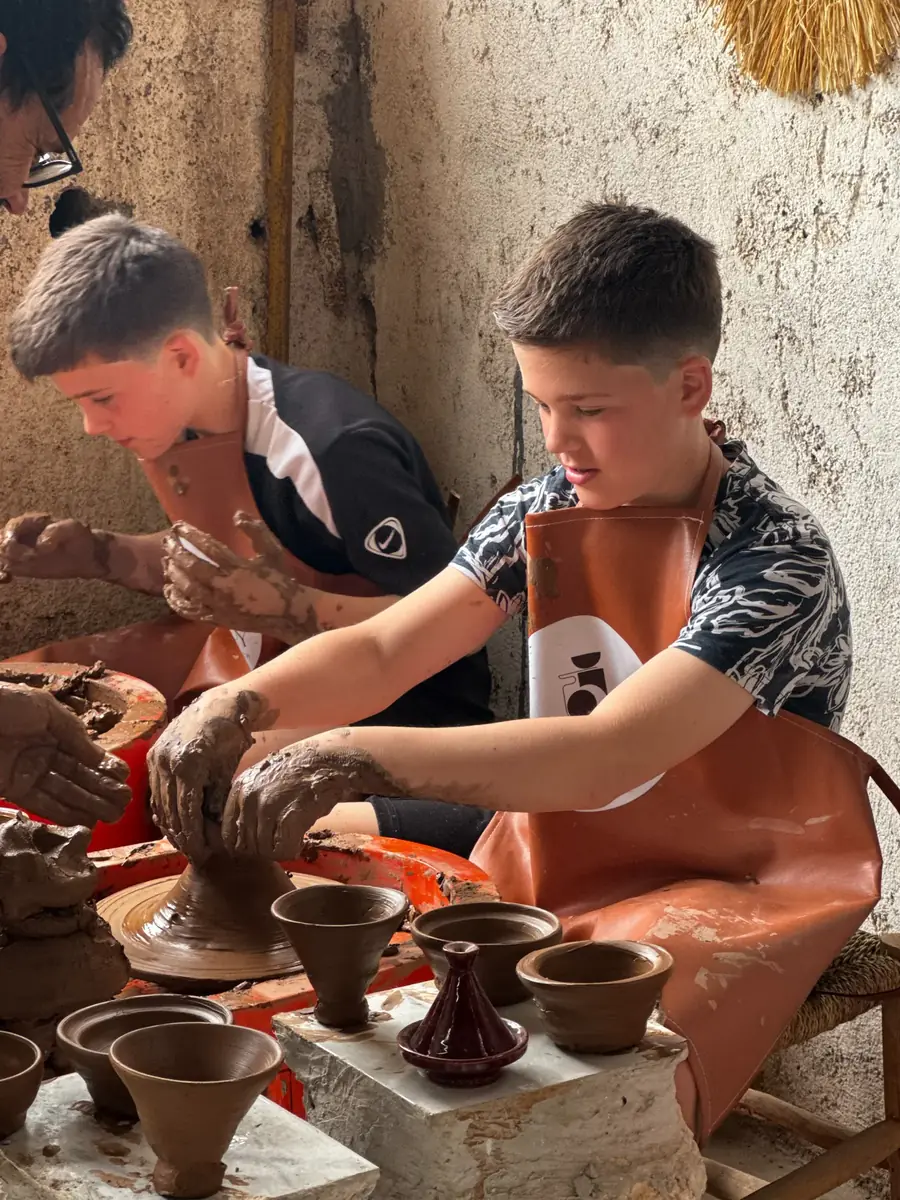
A pottery or zellige workshop is a practical team-building activity in Marrakech: two hours, a local artisan, no experience needed, and a group of up to 50 people working with their hands instead of in a meeting room. Pottery and ceramic painting start from 40€ per person and zellige from 60€, with all materials, tools and guidance included. This guide explains why craft workshops work for teams, how to choose between pottery, zellige and ceramic painting, how to organise the session, and what to ask us before you book.
Team events often fail because they feel artificial. A craft workshop is different: the activity is real, the instructor is an expert, and the result is an object that each person made. There is no forced icebreaker and no winner, and that is what makes it comfortable for colleagues who do not know each other well.
Why a craft workshop works for teams
- Everyone is a beginner. The manager and the intern start from the same place. This levels the room more effectively than many dedicated team exercises.
- The task is concrete. People concentrate on the clay, the tile or the brush, so conversations happen naturally, side by side, rather than face to face.
- It is cultural. If your team is visiting Marrakech, the workshop is a way to connect with the place and its craft, instead of staying inside a hotel.
- It produces something. At the end, each person has a piece that reminds them of the day.
- It suits mixed groups. Different ages, languages and levels of confidence can all take part. Our workshops run in Arabic, English, French and Spanish.
Which workshop for which team?
| Workshop | Style | Group size | From | Good for |
|---|---|---|---|---|
| Poterie | Energetic, tactile and humorous | Up to 50 | 40€ | Teams who want movement and laughter |
| Zellige | Focused and collaborative, like a puzzle | Up to 50 | 60€ | Detail-oriented teams, designers, engineers |
| Ceramic painting | Calm, creative and sociable | Up to 40 | 40€ | Teams who want a relaxed, conversational session |
If you are unsure, tell us the size of the team, how well people know each other and what mood you want, and we will recommend one.
What the session looks like
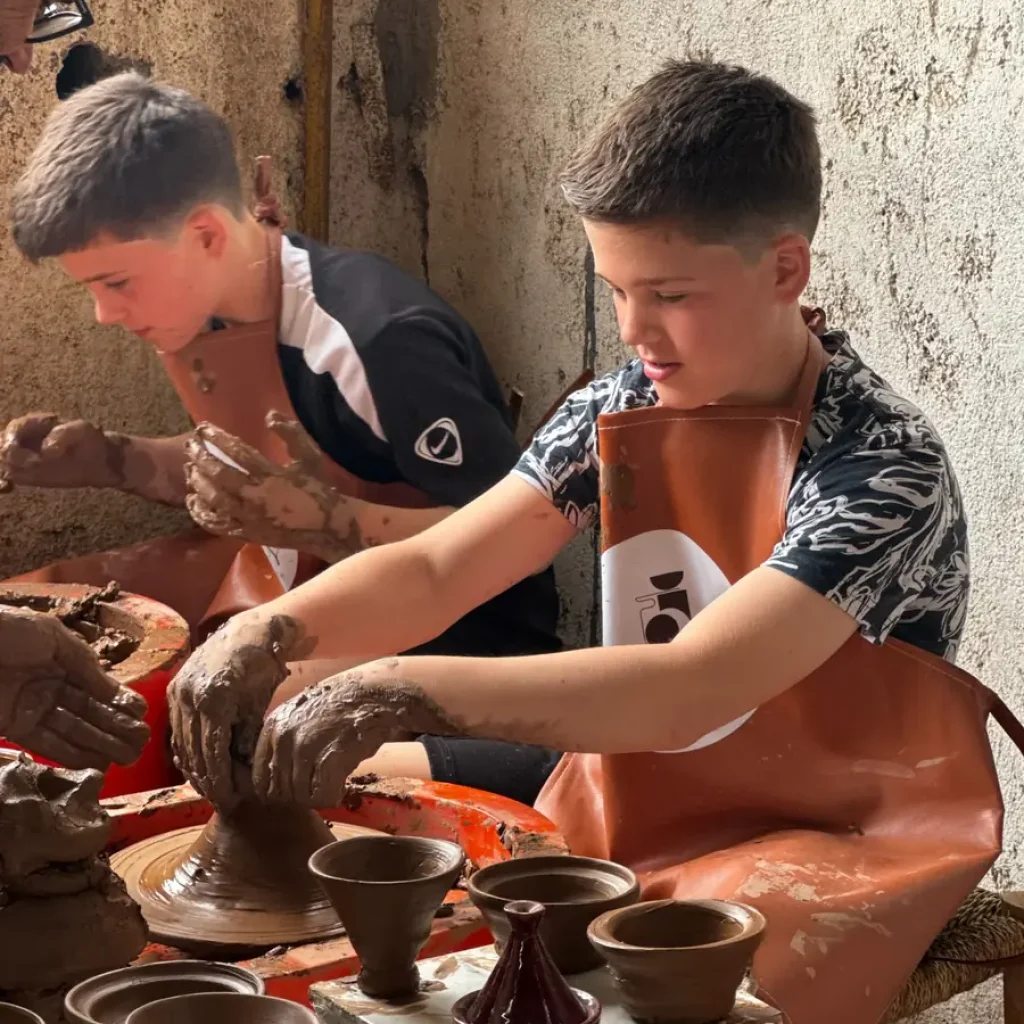
Every workshop lasts two hours and has the same rhythm: a welcome, a short introduction to the craft, then plenty of hands-on time. In the pottery version, the group is welcomed with tea or coffee, prepares the clay by hand, works on the wheel and by hand-building with the artisan’s guidance, glazes the piece and finishes with practical questions about drying, firing and pickup. In zellige, the group learns the history and the patterns, cuts and shapes the tiles, and assembles a pattern. In ceramic painting, everyone chooses a plate, bowl or tile, sketches a design and paints it.
In a team context, it helps to let people work at their own pace rather than compete. A short moment at the end, where everyone shows what they made, is often the most memorable.
How to organise it
- Choose the objective. Do you want a reward, a bonding moment or a creative break? The objective helps you choose between pottery, zellige and painting.
- Fix the number of participants. Our maximum is 50 for pottery and zellige, and 40 for ceramic painting. If your team is larger, contact us to discuss how to split it.
- Choose the date and time. Ceramic painting runs Monday to Saturday at 10:00, 11:00, 15:00, 16:00 and 17:00. For other workshops, tell us your preferred time and we confirm.
- Tell us the language. We run sessions in Arabic, English, French and Spanish.
- Confirm with us. Message us on WhatsApp with your numbers and date. For a group or special request, we discuss the details with you directly.
- Share the practical details with your team. After confirmation we send the workshop address. Bookings are made through our office in Guéliz, Marrakech.
What to ask us before you book
Corporate groups usually have specific needs. Here are the questions worth raising, so that we can confirm them in writing:
- The exact number of participants and the date
- The workshop you prefer and your preferred time slot
- The languages spoken in your group
- Any participants with mobility or accessibility needs
- Whether you want to add an activity before or after the workshop
- Your invoicing or payment requirements, so we can tell you what is possible
We do not want to promise something we cannot confirm for your date, so we prefer to answer these questions directly rather than publish a fixed package.
What is included
- All materials, tools and equipment
- Instruction and on-site help from local artisans
- Tea or coffee for pottery, and a hot or cold drink for ceramic painting
- For zellige, a small piece to take home, and for ceramic painting, your finished decorated piece
Pottery pieces need to dry and be fired before they are finished. Ask the artisan about timing, and tell us your departure date if your team is travelling, so that we can advise you on collection.
Making the most of the session
- Brief the team in advance. A short message with the time, the dress code (clothes that can get dirty) and the duration reduces stress on the day.
- Do not turn it into a competition. If you want a light challenge, make it playful, for example by letting people name their piece.
- Mix the groups. Seat people next to colleagues from other departments so that they talk.
- Leave time afterwards. A relaxed lunch or tea after the workshop lets people reflect on the experience.
- Keep the pieces. A handmade object from a team trip is a good reminder for months afterwards.
Beyond the workshop
If your team likes the idea of a handmade souvenir without making one, our shop sells ceramic cups, mugs, bowls and a plate, made by artisans of Marrakech. Pieces are priced from 5€ each, with offers when you buy several, and shipping is quoted by country. For other types of group, see our guide to private and group pottery workshops in Marrakech.
What a team can learn from making something by hand
A craft workshop is not a training course, but people often notice a few things about themselves and each other. These are observations from how groups behave in a workshop, not promises of results.
- Patience. Clay does not respond to hurry. People who rush tend to find that their piece collapses, and they slow down. It is a quiet lesson in focus.
- Asking for help. The artisan is there to help, and the people who ask early usually do better. Seeing a senior colleague ask for help is memorable.
- Different styles. Some people plan carefully, others improvise. Both styles produce a good piece, and sitting side by side makes the differences visible and friendly.
- Accepting imperfection. Handmade work is never identical. This is a relief for perfectionists, and it often leads to conversations about how the team handles mistakes.
- Celebrating others. When someone finally centres their clay or cuts a clean tile, the room notices. Small shared victories build goodwill.
An example half-day programme
This is an example, not a package. You can adapt the structure to your team, your hotel and your schedule.
| Time | Activity |
|---|---|
| Morning | Your own meeting or free time |
| Late morning or afternoon | Two-hour workshop: pottery, zellige or ceramic painting |
| After the workshop | Lunch or tea together, where the team shows and discusses what they made |
| Rest of the day | Free time or your next activity |
For ceramic painting, the available start times are 10:00, 11:00, 15:00, 16:00 and 17:00, Monday to Saturday. For pottery and zellige, tell us your preferred time and we will confirm. Plan your transport to the workshop address, which we send after confirmation.
A checklist for the organiser
If you are in charge of the event, this checklist helps you cover the essentials:
- Headcount confirmed, including anyone who may join at the last minute
- Workshop chosen and date agreed
- Language of the session confirmed (Arabic, English, French or Spanish)
- Participants informed of the time, the address and the dress code
- Special needs communicated to us in advance
- Transport arranged to and from the workshop
- A plan for what happens after the session
- Photos assigned to one person, since hands will be dirty
- For pottery, a plan for collecting pieces after drying and firing, especially if the team leaves Marrakech
A short message you can send to your team
You can copy and adapt this:
Hi everyone. On [date] at [time] we will take part in a two-hour [pottery / zellige / ceramic painting] workshop in Marrakech with a local artisan. No experience is needed. Please wear clothes you do not mind getting a little dirty, avoid rings and bracelets, and bring water. We will meet at [address, sent after confirmation]. See you there.
Team workshop budget example
Because the price is per person, you can estimate the budget quickly. These examples use our starting prices:
| Team size | Workshop | Estimated total |
|---|---|---|
| 10 people | Pottery or ceramic painting | From 400€ |
| 20 people | Poterie | From 800€ |
| 30 people | Zellige | From 1,800€ |
| 40 people | Ceramic painting | From 1,600€ |
These are estimates based on starting prices per person. For the exact total, message us with your numbers, date and workshop.
Frequently asked questions
What is the maximum group size?
Up to 50 people for pottery and zellige, and up to 40 for ceramic painting.
Do participants need experience?
No. All levels are welcome, and an artisan guides each step.
How long does the session last?
Two hours.
What does it cost?
From 40€ per person for pottery and ceramic painting, and from 60€ per person for zellige. For the total for your team, message us.
Which languages are available?
Arabe, anglais, français et espagnol.
Can we cancel?
Cancellation is free up to one day before the class.
Where is it?
Bookings are handled through our office in Guéliz, Marrakech, and the workshop address follows your confirmation.
Can we take our pieces home?
Yes. Zellige and ceramic painting pieces come home with you the same day. Pottery pieces need drying and firing first.
Planning a team event in Marrakech? Message us on WhatsApp at +212 660 86 10 10 with your date and numbers, or write to book@potteryclassmarrakech.ma.

This sounds like a wonderful team-building experience! I love how pottery and zellige workshops encourage creativity, patience, and collaboration while allowing everyone to learn something new. It’s also a great way to explore Moroccan culture through traditional craftsmanship. The idea of creating something together and taking home a personal souvenir makes the experience even more meaningful. Thanks for sharing