
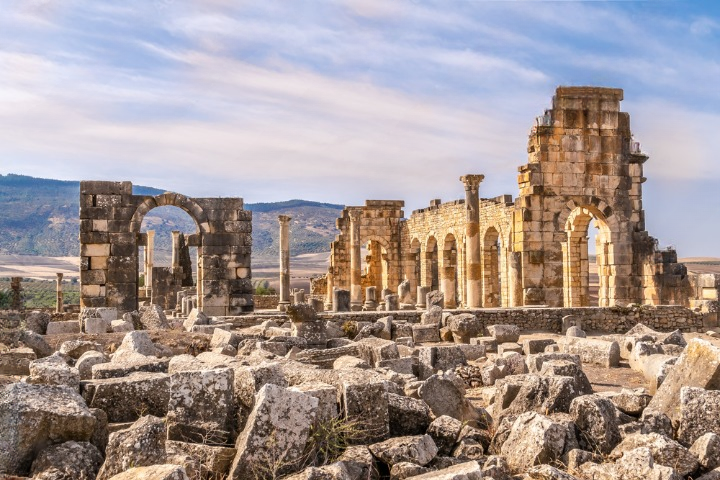
Some may see it as just a pile of stones or a heap of soil, while others might consider it mere worthless debris. In truth, these people overlook its historical, archaeological, and touristic value. They fail to recognize the countless historical events it witnessed, which have left their traces within its ruins to this very day. That is why it rightfully earned the title of “Museum of Civilization.” Yes, this is the city of Volubilis, or rather, the ruins of Volubilis—one of the most important archaeological sites in Morocco.
The Origins of Volubilis
In the past, when agriculture served as the primary means of survival, people sought specific conditions before settling in a region. Two crucial factors influenced their decision: abundant water and fertile land. Volubilis, situated on the slopes of Mount Zerhoun, provided both. The city benefited from nearby rivers, such as Wadi Khoumane and Wadi Fertassa, which supported agricultural activity and made settlement possible.
There is no definite explanation for why the city was named Volubilis. However, one theory suggests that it is the Latin version of the Berber word “Walilit,” meaning lily, a flower that grows along the riverbanks. While this is only a hypothesis, there is no concrete evidence to confirm it. The origin of the city’s name remains a mystery.
The Long History of Volubilis
According to some sources, the city dates back to the Stone Age, around 5000 BC. Fossils from that era were discovered in its ruins, supporting this claim.
Over the centuries, many civilizations left their mark on Volubilis. After the Roman occupation ended, the Byzantines took control of the city. Islamic coins discovered in the ruins show that Islam arrived in Morocco during the 8th century AD. A well-known story about Volubilis is that it served as the burial site of Idris I, the founder of Fez. He was assassinated in the city under the orders of the Caliph of Baghdad, Harun al-Rashid.
From Abandonment to Rediscovery
By the 14th century, people had abandoned the city. Over time, it became forgotten, and legends began to circulate. People started calling it “Pharaoh’s Palace” or “Pharaoh’s Castle,” due to a myth that the ancient Egyptians built it. Despite facing destruction, the buildings of Volubilis remained standing. However, during the 17th century, Moulay Ismail ibn Sharif plundered the city for building materials to construct his new capital in Meknes. Then, in the 18th century, an earthquake struck the region. The ruins of Volubilis remained hidden until their rediscovery in the 19th century.
The stories, civilizations, and valuable historical information contained within Volubilis are vast. It is impossible to detail them all in this brief article. However, we offer you an invitation to visit the city. Come explore the remnants of history that still stand in this remarkable archaeological site.

Comment (0)