
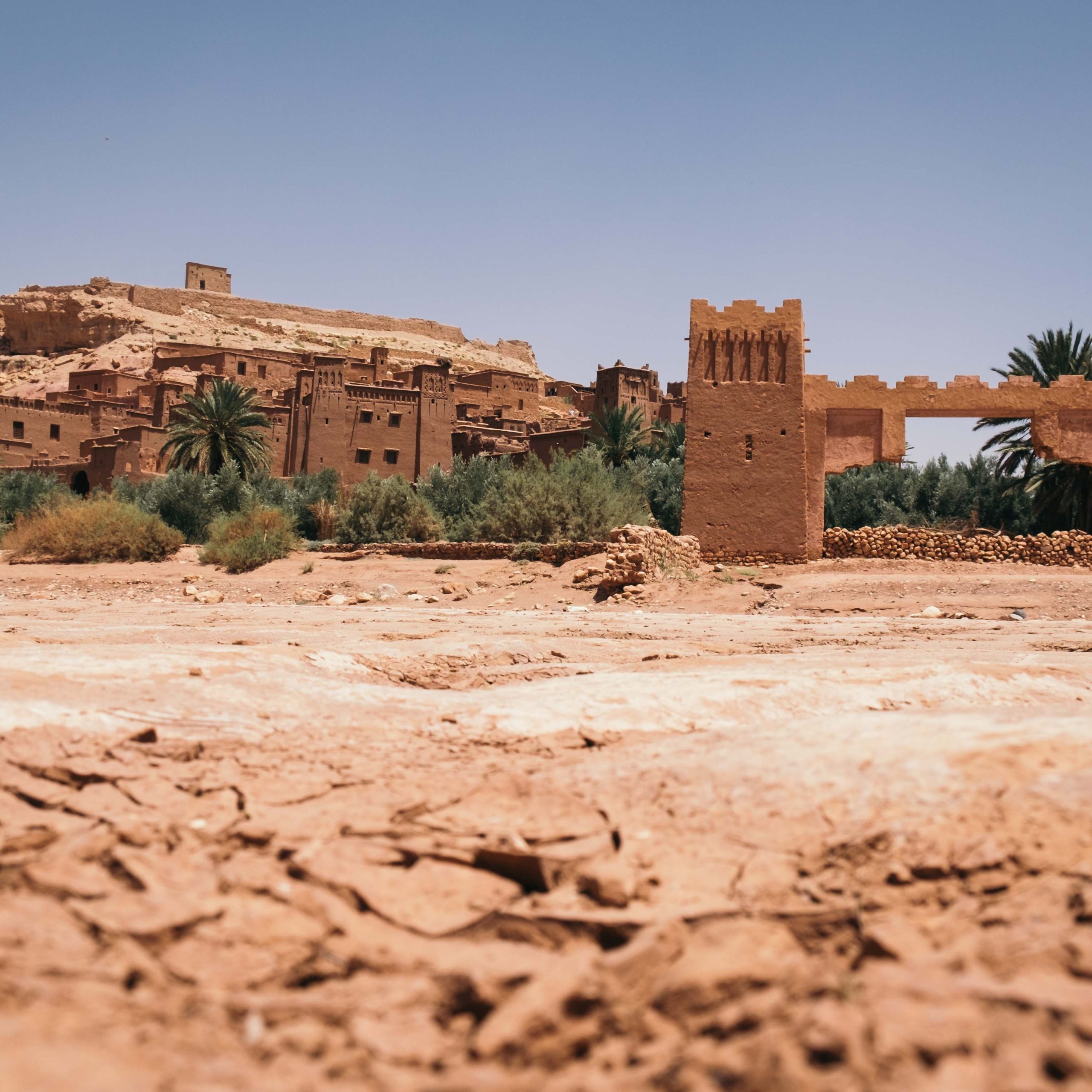
Although it is neither the first nor the only place where homes were built using clay, one’s admiration grows upon seeing the unique architectural creativity of these clay homes scattered across various cities in Morocco. This ingenuity has attracted tourists, especially in desert cities like Ouarzazate, Tazarin, and Zagora. However, today we unveil one of the most remarkable landmarks in the High Atlas Mountains: Aït Benhaddou.
Aït Benhaddou: A Masterpiece of Design and Heritage
Aït Benhaddou, or rather, let’s call it the Kasbah of Aït Benhaddou, is a collection of beautifully designed and meticulously crafted buildings that reflect the heritage and culture of Morocco from a bygone era. The construction of Aït Benhaddou began in the 16th century, along the Draa Valley, Todgha Valley, Dades Valley, M’Goun Valley, Ziz Valley, and Sous Valley. Imagine that we are now in the 21st century, and these clay and wood houses have withstood the test of time and harsh climate for nearly five centuries! Isn’t that incredible?
Architectural Marvel on the High Atlas Slopes
Perched on the first hills of the southern High Atlas, the Kasbah of Ait Benhaddou has maintained its shape, intricate architectural design, and artistic construction, despite being built with simple materials. This has caught the attention of many people—visitors who are enchanted by its distinct design, historians, geographers, and sociologists, who see it as a site that continues to preserve traces of history. Of course, the kasbah has also intrigued engineers, who remain in awe of this architectural marvel, standing as a testament to ancient construction methods.
The Story Behind Aït Benhaddou’s Name
It is widely believed that Ait Benhaddou was named after its first ruler, Amghar Ben haddou, who lived there during the Almoravid era, and the site has carried his name ever since.
A UNESCO World Heritage Site
In 1987, due to its historical significance, UNESCO decided to include Ait Ben haddou in the World Heritage list. The kasbah has retained its authenticity, with its original building materials and architectural style still intact. In short, time has not been able to steal its youth, beauty, or authenticity.
Aït Benhaddou: A Living Landmark
Today, a few families still reside in Ait Ben haddou. It also contains public spaces such as a mosque, a public square, two cemeteries—one Jewish and one Muslim—and the shrine of the pious Sidi Ali Oumar, along with a guesthouse for travelers.
The people of Ouarzazate are known for their generosity, hospitality, and humility, which is deeply ingrained in their culture. So, if you ever decide to visit this tourist destination, famous for Ait Benhaddou, be prepared for a flood of warm invitations from every direction.

Comment (0)