
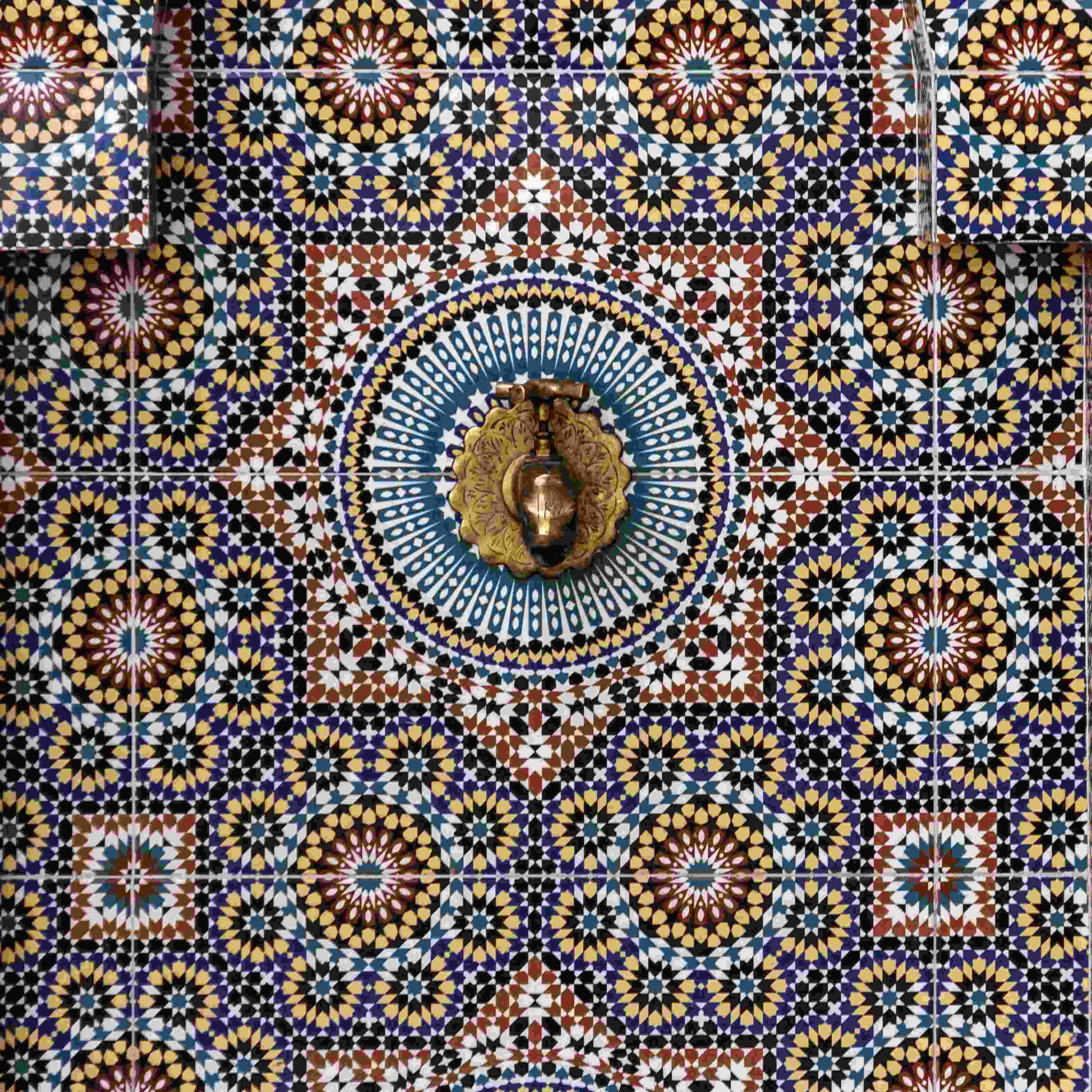
If you ever enter one of the Islamic historical landmarks in an Arab city, or even just a mosque to perform your prayers, you might find yourself drawn to the shapes and decorations on the walls, columns, or even the floor. Yes, we are talking about the Moroccan art of Zellij.
The Origins of Zellij
Zellij emerged and developed in the Maghreb and Andalusia during the Middle Ages, around the 11th century AD. This art flourished in Fez, now considered the capital of this craft, as well as in Meknes and Tlemcen.
Zellij’s Global Fame
Thanks to its unique artistic features, Zellij gained widespread fame and interest. Countries in the Gulf, Europe, and America admired its craftsmanship. It also captured the attention of visual artists, architects, and lovers of authenticity and heritage. Over the ages, Zellij adapted to change while maintaining its distinctive character and form, expressing culture and heritage.
What is Zellij?
Zellij refers to a panel of plaster covered with geometric ceramic shapes, designed piece by piece. It is also an ancient Islamic and Moroccan art of mosaic tiles that developed in the Maghreb and Andalusia.
The Stages of Zellij Production
First, the craftsman kneads the clay with his hands and feet until it becomes soft and smooth. Then, he stretches and cuts it, leaving it in the sun for a while. He cuts the clay into small pieces on a wooden board, not exceeding ten centimeters, and leaves them to dry. The face of these squares is then placed on the paint and fired to create a mosaic piece in a specific color. Afterward, the craftsman polishes each piece individually to shape it. Finally, during the assembly stage, the craftsman arranges the mosaic shapes on a plaster board with precise dimensions, giving Zellij its unique appearance.
The Pride of Moroccan Heritage
The production of Zellij remains one of Morocco’s proudest industries. Although made from modest materials, like painted dried clay, the craftsmanship of the maker elevates it to represent Moroccan heritage. The intricate designs of Zellij appear in historical monuments, palaces, and even simple homes, preserving a tradition that Morocco cannot do without.

Comment (0)