

The word “Zellij” means “small polished stone”. The word has sometimes been spelled zillij or zellij. This ornamental technique, typical of Maghrebian architecture, consists in assembling shards of glazed terracotta tiles in different colors to create a geometric pattern. The shards of earthenware are sometimes so fine that they create a veritable ceramic marquetry.
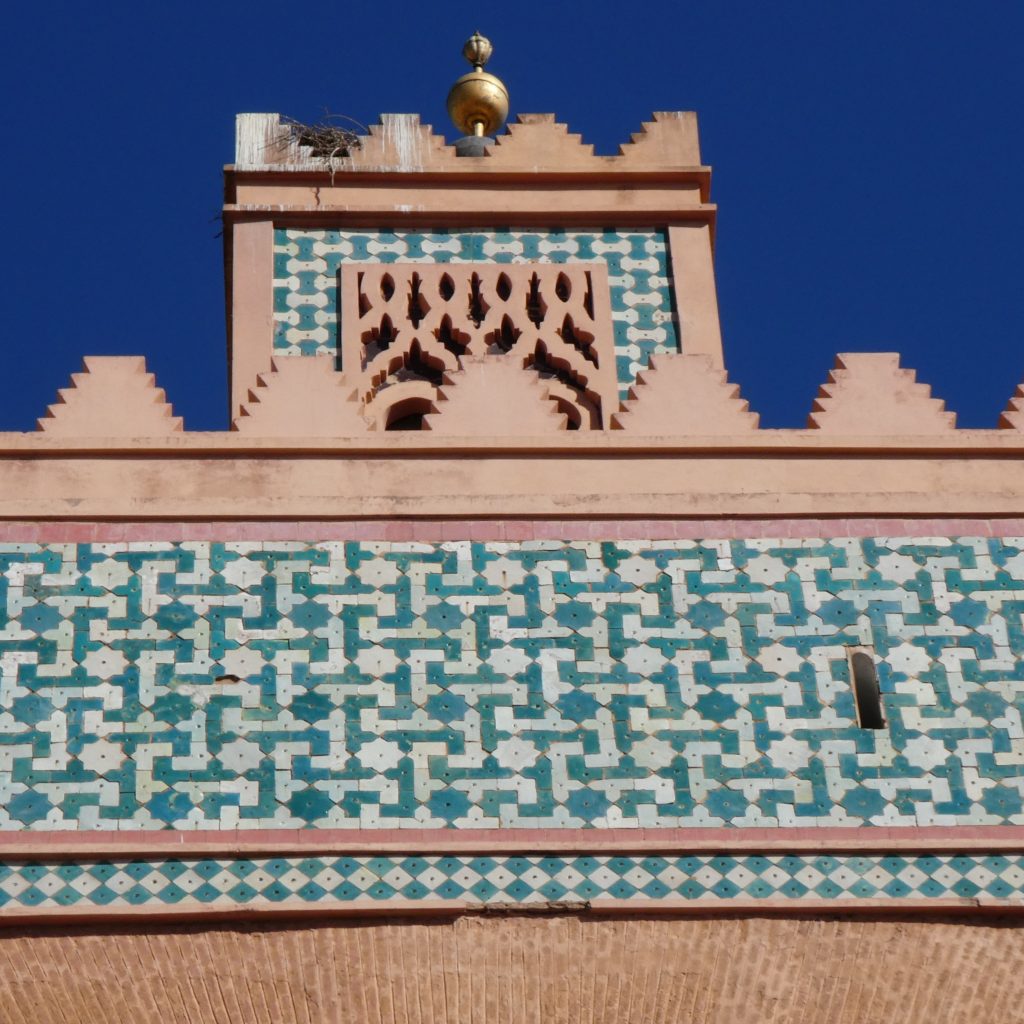
Why “small polished stone”? Because the original idea was to imitate the Greco-Roman mosaics of North Africa, not by assembling pieces of polished marble (“tesserae”), but fragments of coloured earthenware tiles. Clearly, cutting an earthenware tile requires less effort than polishing pieces of marble from distant origins !
The depiction of human beings, or even animals, was often forbidden in Islamic art. This explains the development of this decorative art governed by geometry. Basic geometric figures such as squares, diamonds, triangles, stars, crosses and polygons are combined according to rigorously mathematical patterns. Thanks to their complementary nature, they form motifs that criss-cross and repeat endlessly.
History
The art of Zellij was born in Morocco around the 10th century A.D., in white and brown tones, in imitation of Roman mosaics. Although the Romans ceased to occupy the region several centuries later, they left numerous vestiges. This art was then constantly enriched by the contributions of the various dynasties that succeeded one another in Morocco and al-Andalus, the part of Spain then under Moorish domination: the Almoravids from the desert, the Almohads from the High Atlas, and last but not least, in the 14th century, the Merinids, originally Berber nomads. During these 4 centuries of exchange, the arts and sciences developed considerably. Architecture and decoration reached their highest levels of refinement, with Zellijs invading the walls of palaces, tombs, fountains, patios and hammams. Colors diversified with the appearance of blue, green and yellow, with red only introduced in the 17th century.

Where to see Zellijs?
Wonderful examples can be seen at the Alhambra Palace in Granada (14th c.), the Medersa el-Attarine in Fez (14th c.), the Nejjarine fountain in Fez, the tomb of Moulay Ismail in Meknes (1700), the Medersa Ben Youssef in Marrakech (16th c.), and more recently, the Kasbah de Télouet (19th c.).
This tradition is still very much alive, as witnessed by the Hassan II Mosque in Casablanca, inaugurated in 1993.
Terracotta tiles were first glazed on one side. In the 9th century, the Persians discovered that tin oxide could be used to render the glaze of a glazed clay opaque. This opaque tin glaze enabled the manufacture of colored tiles using the same metallic pigments used to color glass. During the Renaissance, these tiles became known in Europe as “faience” tiles, as the Italian town of Faenza became an important center for majolica production.
Tiles are cut in 3 stages: the geometric shape to be cut (square, star, triangle, rhombus, rounded shape, etc.) is traced with a brush on the glazed tile, the shape is cut by hand using a sharp hammer (“menqach”), and the edges are beveled using a smaller hammer.
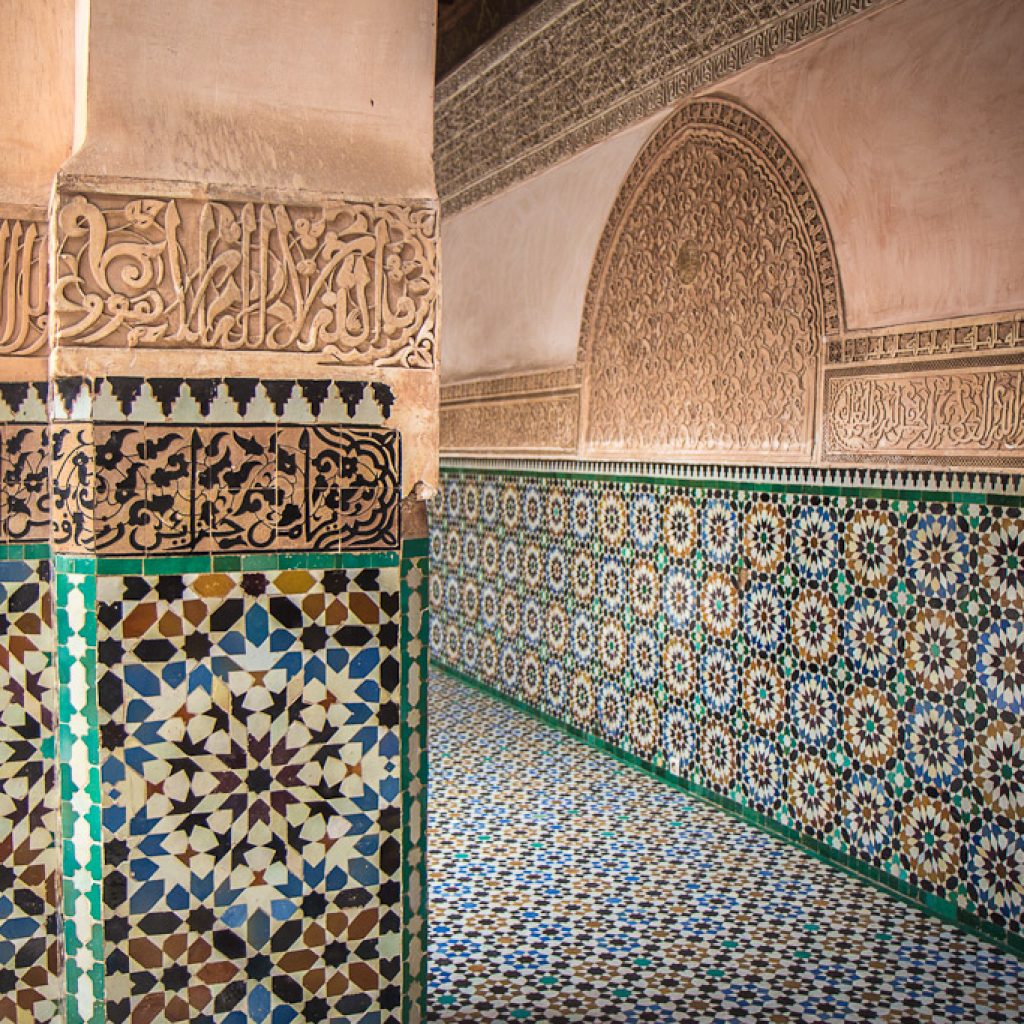
The final pattern is prepared by “master Zellij’s” who detail the assembly of shapes and colors on a drawing. The cut shards are assembled upside down, glazed side down, on a smooth floor, with the finest possible joints. When the assembly is complete, the tesserae are held together by a mortar into which iron bars are embedded for strength. Once the mortar is dry, the resulting slab is lifted and fixed to the walls.

Comment (0)